




AI Is Enabling a Composable Approach, Creating the Environment to Innovate.
The problem is that most platforms force you into a compromise, and even minor compromises compound. The Platform Effect also draws you towards the status quo, the average, the way everyone else does things. That removes differentiation.
AI in its generative form is, I believe, moving us closer to a way of supporting our businesses technologically that is more like a glove and less like a mitten.
Cloud computing gave us Software as a Service (SaaS). But that was really just porting applications we used to buy and install on our desktops into an environment where we rented them. The way the applications themselves worked and were designed to work did not really change.
While it allowed the vendors of the SaaS solutions to iterate faster and ship functionality quicker to serve user needs, it still left us with the same old problem.
In smaller businesses, you are often trying to bend your operations to the way a particular tool works. As opposed to having the freedom to design your ideal experience and the tool matching that.
One of the things that generative AI has enabled is our ability to create tooling that matches our needs much more precisely than we've ever had before.
As a small example of this, for this website, we wanted to highly optimise our images to make sure that they are of the right size and optimised for speed no matter what device you're using. Now, we looked around and we found SaaS platforms that would do that, but at a cost. What generative AI allowed us to do was to talk into existence a microservice that we have been using ever since, which does that same job for pennies.
What is a Composable Approach
Before I go into this, let's take a step back and look at the problem it solves. In many of my digital transformation projects, the first job was always to audit what tech or, for want of a better word, what subscriptions were running in the business. In one small media business, we uncovered over 40 subscriptions to various services.
None of them were used to their full potential, but each one provided a useful outcome to that business's operations. And more often than not, they were only needed at certain points in time.
That, for me, is a major source of frustration because you don't have to be a technical genius to spot the waste in what I have just described. It is, however, a recognisable status quo for a lot of businesses. And I have always felt there must be a better way, and one of the ways that has been solved is through automation middleware like n8n and make.com, but it still does not fully optimise for outcomes.
I have always envisioned solving this by spinning up numerous small microservices or calling APIs to deliver business outcomes with minimal waste in terms of cost and increasing efficiency.
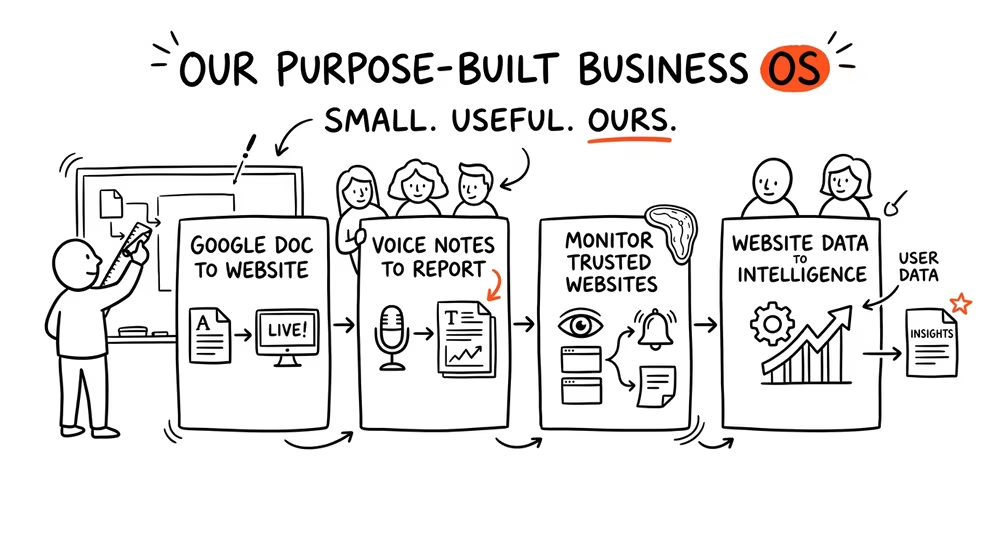
Saving over £24,000 on operations
One of the big things about Digitising Events is the ability to test these assumptions in a controlled environment. By using this approach, we saved over £24,000 in our operations. When working on building out a methodology to be able to offer this approach to other businesses, I stumbled across a very old and orphaned Gartner paper that used the word ‘composable’ to explain this approach so ‘Composable’ it is.
But whereas Gartner called it composable architecture, I would prefer to use the word ‘composable systems’. The reason for this is that with generative AI, we can start getting closer to more outcome-centric vocabulary rather than immediately going to tech-centric vocabulary. This may be a nuance, but I think it's an important one to get behind. As it removes friction that is inherent in the over-use of jargon.
How it works: Composable Systems in practice
At the root of enabling this approach is the realisation, which is now a reality, that if you have a problem that can be very well defined and containerised, the chances are very high that, with the aid of generative AI, you can either build an application or create a microservice to solve that problem.
This enables you to approach how you underpin your business with technology in a very different way. You move from the world where you gather a tonne of requirements and then try and find the best-fit SaaS solution. To a world where you very accurately define specific problems and either find the right Application Programming Interface (API) or build very quickly a microservice to solve that problem. And then in your system of work, you stitch those together.
If that conjures up in your mind an image of LEGO blocks, you're not far off, but imagine being able to take it one step further and being able to manifest your own little LEGO block with ease. What could you build in that world?
What I have described has been achievable for a while, but what has happened with the rapid maturing of generative AI models and solutions is the removal of friction. I was speaking to a friend about this, and their words were: "Generating the code is no longer the problem. It's how you use that to compose your new systems of work is where commercial advantage lies."
What most people building SaaS systems fail to realise is that for many a Small and Medium-sized Enterprise (SME), we are not dealing with billions of lines of data or thousands of transactions an hour. Our reality is small data and a low number of critical transactions. That is why a composable approach is such a good fit.
Another good real-world manifestation of this approach is all the platforms that are appearing with the promise of ‘just think it and we'll build an app for you’. Take as an example, Lovable. If you look at the integrations, that is all foundationally composable architecture. The way it works on Lovable, for example, if you wanted an event registration system, you just take a boilerplate, clone it, and make it your own.
Gartner’s View: Composable Architecture
As I started building out this approach, probably a year ago on Digitising Events, as I mentioned earlier in the article, I was looking for a way to articulate it and came across Gartner's work on this. I felt it would help to include my summary of my readings of that work here.
Gartner uses the term ‘composable architecture’ to describe a way of designing digital foundations out of small, well‑defined building blocks rather than large, monolithic systems. In their view, each block is focused on a specific business capability, exposes that capability cleanly through APIs, and can be deployed, replaced, or recombined without disturbing the rest of the system.
If you look at further validation that this approach has backing, look at the funding n8n, an open-source workflow integration tool, raised; their vision is 100% aligned to this approach.
Gartner further extends this idea into what they call a ‘composable enterprise’ (This part, in my view, is a bit of a stretch, but I understand the theoretical concept. It is in no small part, in my view, based on Kaizen.)
It is an organisation built from interchangeable blocks of process and technology that can be rearranged quickly as markets, customer behaviour, or internal priorities change. Instead of locking yourself into one big platform, you assemble a library of components: registration, badging, content delivery, identity, analytics, and use them in different combinations to create new products and experiences.
In Gartner’s language, a modern digital platform should therefore be modular and API‑first, composed of ‘packaged business capabilities’ that are discrete, task‑oriented and independently deployable. The aim is not just technical neatness, but an operating model where you can adapt faster, experiment with lower risk, and retire or upgrade parts of your ‘stack’ without having to rebuild everything from scratch.
This is the lens through which Gartner argues that composable architecture “shapes the new digital foundation”: by turning technology and process into configurable blocks, it becomes easier to support new business models, integrate emerging technologies, and respond with more agility to disruption.
Provided, of course, as I go into below, the organisation is willing to rethink how it designs and governs its systems of work.
What is the downside
The downside of this approach is that we are conditioned to go tech-first. A composable approach forces you into going process-first and, most importantly, also reimagining processes behind very clear outcomes.
You also move into a world away from a few big changes to many small changes. That, for many businesses, is a cultural shift. Which, in my view, is the biggest downside.
The other one is that, while this approach can deliver a system of work that fits more like a glove than a mitten, you do need a reasonably high foundational level of data literacy and tech affinity to make it work.
The website, though, may just be enough to pull you in this direction. We have proven in our operations when we flip to this approach that we save £24,000, and our operations are just touching the sides of what a going concern might be needing. We have also proven internally within our operations that this approach frees time. And we have proven that this composable approach will deliver viable and production-grade solutions incredibly quickly.
And we are already seeing some benefit of this: we can now reinvest the savings we've made in other areas. Freeing up time is letting us be more strategic in our daily operations, and for us we are, I believe, on our road to becoming adopters of composable systems.
However, if you compound this with the rapid pace of change driven by AI, then this way of operating, to me, feels like the only sustainable way to keep up.