

This is the first in a series of five articles examining the major technological megatrends driven by AI that are expected to influence SMEs in the coming months and years. These insights stem from an 18-month sabbatical focused intensely on AI, combined with my long experience navigating tech cycles since the mid 90s.
This understanding is informed by attending various grungy events in strange places, experimenting with new tools, and, crucially, building this site as an AI powered media platform. This platform demonstrates the potential of an AI-Powered Media Business and allows me to assess the real-world operational impact of this technology.
I have also done my best to divine where the market is actually going, rather than where the hype says it should, through personal, off-the-record conversations.
My fundamental belief? This is ground-zero technology. No one yet knows how to make the most of it. That is why nearly every AI execution in 2025 felt like "we can already do this – why do I need AI?"
Significant Cost Uncertainty With Overall 20%-30% Tech Cost Inflation
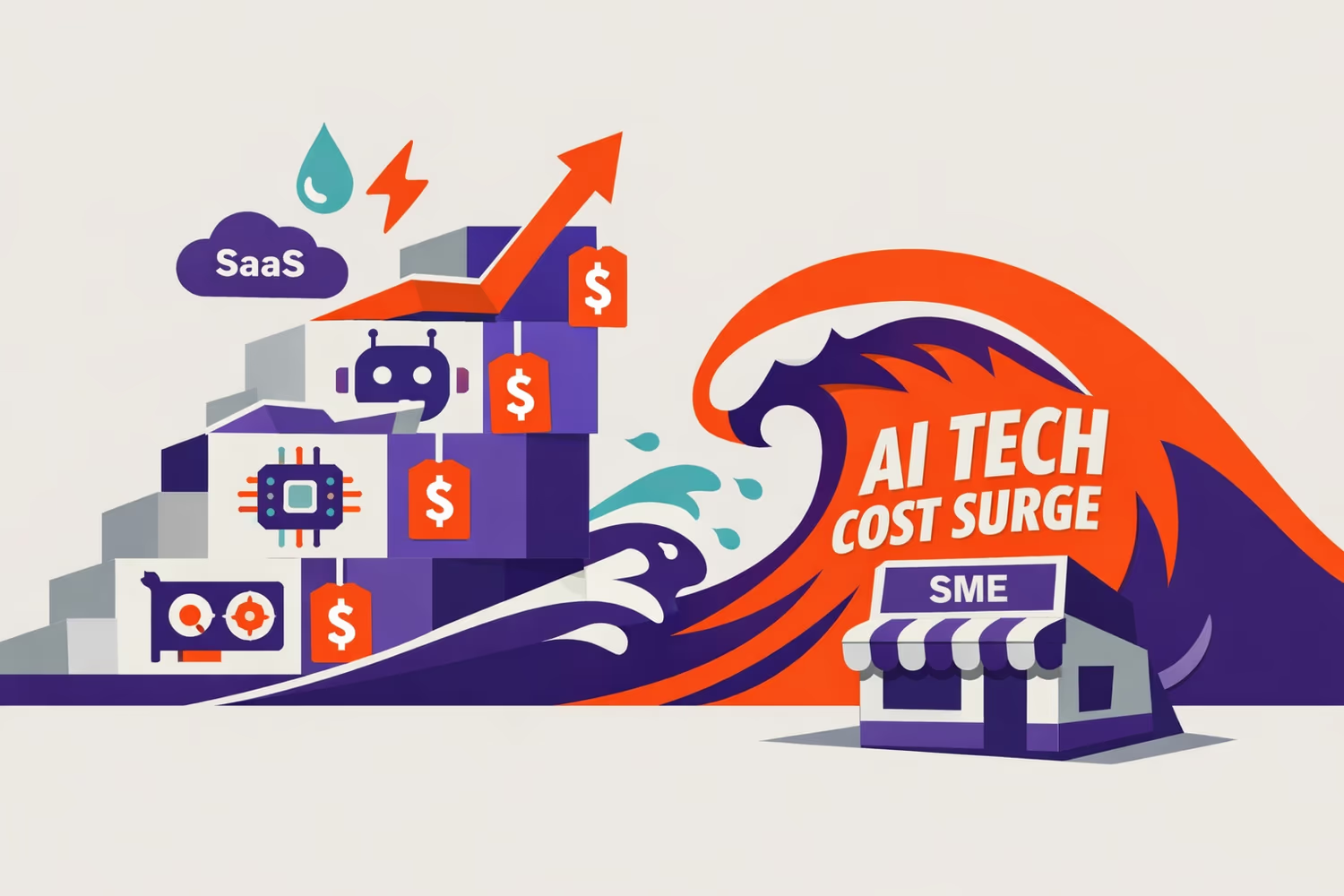
Bottom line, if you are a Small or Medium Enterprise (SME), you are looking at tech inflation running at 20-30% and a change in how you control those costs because they are about to become unpredictable. This will affect how you, as an SME, will need to budget and plan. There are also opportunities for cost savings if you are willing to utilise AI in more imaginative ways.
Here is why.
AI did not arrive like normal technology. ChatGPT in 2023 triggered something anthropological that, one year later, synchronised tech adoption cycles, creating converging cost pressures, land grabs, and business models that will hit your business from multiple directions over the coming months and years.
Before I show you where those pressures are coming from, indulge me for a minute and let me explain what makes this tech wave different. It is one of the strangest technologies I have come across. It is almost like a reverse K-T boundary. One minute, no global consciousness of AI; the next, pervasive AI saturation.
That is unprecedented in any wave of technology that has created its own playbook, and, in my view, it has created a bubble of bubbles that we have never navigated before. The first bubble is gen AI itself, and the second is all the existing solutions spending a fortune to bake it into their products.
The Anthropological Trigger and Syncronicity
What does that have to do with costs? Bear with me a little bit longer. I will come onto that.
Generative AI pulled an anthropological trigger, a deep one. And this is just one of the connections I have made: the timing was perfect for it to arrive right after COVID, when the whole world had a period of not chatting or interacting. Even though COVID was over and we were back to talking to each other at work, those subconscious triggers from that time remained: feeling somewhat trapped and isolated, and wondering if we were living through Ragnarok.
ChatGPT fed into that. You can see that in how people are using it. It almost immediately created an expectation and a sense of validation that we, as people, are ready to talk to technology and have it do things for us, to abdicate some of the grunt work.
The number of people who anthropomorphise this technology is crazy. You don't hit save on your CRM system and then thank it for saving the information. However, after a chat with ChatGPT, Claude, etc., most people I have spoken to have been polite and thanked it. That's weird.
The most important thing, though, is how it synchronised everything. The money flowed into foundational AI models; it flowed into existing products because, without AI, your spreadsheet is apparently useless, and all sorts of other defensive reasons meant no existing product was valid without being able to slap AI into it.
So everyone freaked out and said this will disrupt how we work, our products, our business models, our jobs, the talent we need, and more. And they are probably right on balance long term; the problem is that, in the past, each of these concerns manifested sequentially over time. With this tech, all of this is playing out in badly choreographed synchronicity.
Now, in this highly charged, highly triggered world, everyone needs money. The people building foundational models for product development, user acquisition, partnerships, etc., need it. The existing SaaS products for integrating AI in every possible way, whether users have asked for it or not.
Existing businesses are rolling it out to users and telling them, "Work with this, and don't you dare ask for headcount; make this AI work for you." The chip manufacturers need to make more chips, the data centre operators need to build more to be ready for its immense computational demand, and the hardware companies need to embed AI into devices, because we would be incapable of figuring out what to do if we put too much sugar into our Gochujang Pasta sauce without AI. I could go on, but I feel I have made my point.
All of this needs cash, and lots of it. One way or another, we will have to pay for it, and there is a problem there as well.
Show me the MONEY!!!
As Jerry McGuire famously said. Here, too, there is a minor issue. How Exactly?
The problem is best illustrated by what Google did, what it did next, and what it continues to do.
In the beginning, they went here: it's Gemini and an extra $20/month, but it's basically ChatGPT. Please sign up. No one probably did; Muggins here did for two months and then realised it was shitGemini.
Pretty soon, Google realised it was rubbish too, but they really needed to understand why. So then they said. Hey Google Workspace user, you will never guess what: shitGemini is now free with your Workspace account, while we make betterGemini by about 2026.
Shortly after that message, if you were a workspace administrator, you received a message in somewhere sound Feb 2023. Hey, your workspace subscription is going to go up. Not by as much as when we wanted to con you out of cash for shitGemini, but by about 20%.
It's still good value, though. We are improving safety and security by logging you out of your account more frequently and at random, especially about 5 minutes before Google Meet calls. Then in 2025, we will hit you up for more cash because shitGemini is now betterGemini and absolutely everywhere, and super helpful. It will turn any Google sheet into a table and use AI to analyse your shopping list that you were sneakily working on at work.
So for me, as a lifetime Google workspace (yes, I was an early Beta user, and was promised the thing for free for life #brokenPromise ), we went from periodic single-digit, inflationary pay rises in the business to a 50% pay hike thanks to AI - proving how expensive this tech is.
As if that did not sound confusing enough, let's look at what is happening with Google diffusion models - image and video generation to you and me. The latest Google model, the one that lets you recognise a banana, is very good, and Veo3 is amazing for video generation.
And you can access them in different ways: the AI Studio, which is pay on consumption; the API, which is also pay on consumption; or Google Flow, which is currently a £78/month subscription. You can also access it in your Gemini app, where you are limited to a few a day and have watermarks.
When you look at the actions Google are taking, you can see the confusion and problems. Do we offer this on a consumption basis, or build a filmmaking app (Flow) and charge a subscription fee?
What you are seeing is pricing experimentation, which would normally be a gradual process over the years, happening simultaneously in a compressed timeframe. And if you are an unsavvy user, you can easily be forking out £78/month when your use case may be better served by a model marketplace or the API route.
Offering Gemini as an add-on to workspace users clearly failed, so it's now coming in like a stealth tax. Google is lucky that the workspace product is good, but even here, they know they need to be seen to be making it better, hence all the “helpful” AI, UI improvements and features being added.
And in a final nod to my synchronicity observation, if we all start demanding AI Overview pages instead of traditional search, that is going to have a serious impact on Google’s bottom line as they cost potentially 10x more to serve.
That is not even taking into account the disruption those AI Overview pages create to Google's revenue model, which is to deliver traffic to you and me at some point, with “devastating drops” reported. Which may be related to the new “Source Preferences” on Google Button we are seeing on publishers' sites.
And at the time of writing this, I got a 'Gemini for BigQuery will be auto-applied' email. So here, too, Google is doing what many others are. Auto-applying chargeable AI rather than asking for your consent. Because just maybe if you are a seasoned BigQuery user, you just may not need Gemini.
The only inference you can logically make from this behaviour, and Google is not alone, is that AI is expensive. It may also not be valuable enough for many people to pay for it proactively.
What this means for you and me is all the players in the market are trying to figure out how to monetise it, as all of them have investors who say, "Show me the money." Why else ‘brute force’ Gemini into the Google Workspace subscription?
Now, let's look at other signals, like OpenAI’s deal with Disney, which, in my opinion, is a featurisation deal. If Disney characters are your thing, maybe you sell Disney memorabilia, then you need Sora, and in time, I can see a monetisation path where you can buy Disney character packs for Sora. To create a video of Darth Vader drinking our of your Micky Mouse mug. Let's put to one side the legal grey areas Disney may not have thought through, because at the moment, AI-generated content is free of copyright in the US.
And another couple if examples from OpenAI: its launch of the agentic commerce protocol with Stripe to sell you stuff inside ChatGPT, and its announcements that they will probably be tuning to advertising proving again not enough of us want to pay for it, and the resulting Super Bowl spat with Anthorpic about the dangers of advertising in your chat bot.
SaaS Platforms: Houston, We Have A Problem
All ‘productivity’ solutions, from your accounting to your CRM, are effectively CRUD: Create, Read, Update, Delete. That's pretty much all you do with them if you factor down to the basics.
Now all the SaaS providers have had to jump on and integrate generative AI, and they've just piled it in everywhere. Some of it is useful, like just loading the invoice, and we will fill in everything. Other stuff is plain stupid, like give me four key points, and I will write a blog post.
My main observation, though, is that a lot of “AI” has been put in, almost acting like a new user interface rather than a new way of doing things. In effect, many SaaS products now run two user interfaces simultaneously.
Now, let's think about this. If the GPT becomes the interface for CRUD‑level tasks across office suites, dev tools, and consumer apps, you’re effectively shifting a huge volume of low‑compute and cheap UI logic into an energy-dense GPU‑accelerated expensive inference.
What that does is squeese the bottom line for SaaS providers, and that squeeze will be passed onto us once they feel the real or perceived competitive threat has passed. Or they will just use dark patterns and put their now “AI Enabled” version into their auto-renewal rather than it being a proactive upgrade, a bit like my Microsoft 365 renewal.
Specialist Plugins
Plugins are making a return. I have seen them pop up everywhere, and here is why. You've got people building foundational AI models that focus on one particular problem, and they are very good at solving that problem.
Take ElevenLabs as an example; they're focusing on synthesising voice. Their probable endgame is enabling authors to create their own audiobooks or direct voiceovers for ads or turn an article like this into a podcast, and to be honest, they aren't that far from it. They've solved one problem well.
Now imagine every single SaaS company trying to solve that same problem. They will probably never do it as well as ElevenLabs.
I'm going to go back in history. When software first came out, there was this concept of plugins. If you needed something done on a particular solution, you'd buy a plugin usually from someone else. It's like a really early version of the App Store, but not an App Store. A plugin store. Those plugins just worked and solved the problem.
Over time, what happened is the SaaS platform companies started thinking, "Hang on a minute, these plugin people are making money that we could be making. Let us recreate the most popular plugins." That's how things evolved its called featurerisation.
The new AI plugins will use API/MCP connections to send work out and receive results because "featurising" foundational models is hard. And this means more incremental costs to you.
These plugins will be priced on a subscription or consumption basis, or a combination of the two.
The bottom line, though, is that your SaaS subscription will now incur additional subscription or consumption costs if you use these plugins.
Paying Twice For The Same Thing
Just as I was writing this, an email from Anthropic arrived announcing a price drop on the team plan. Why? Not because they are making more money, but because they want to grab market share. Same as OpenAI.
And all of them are building connectors like crazy. Why?
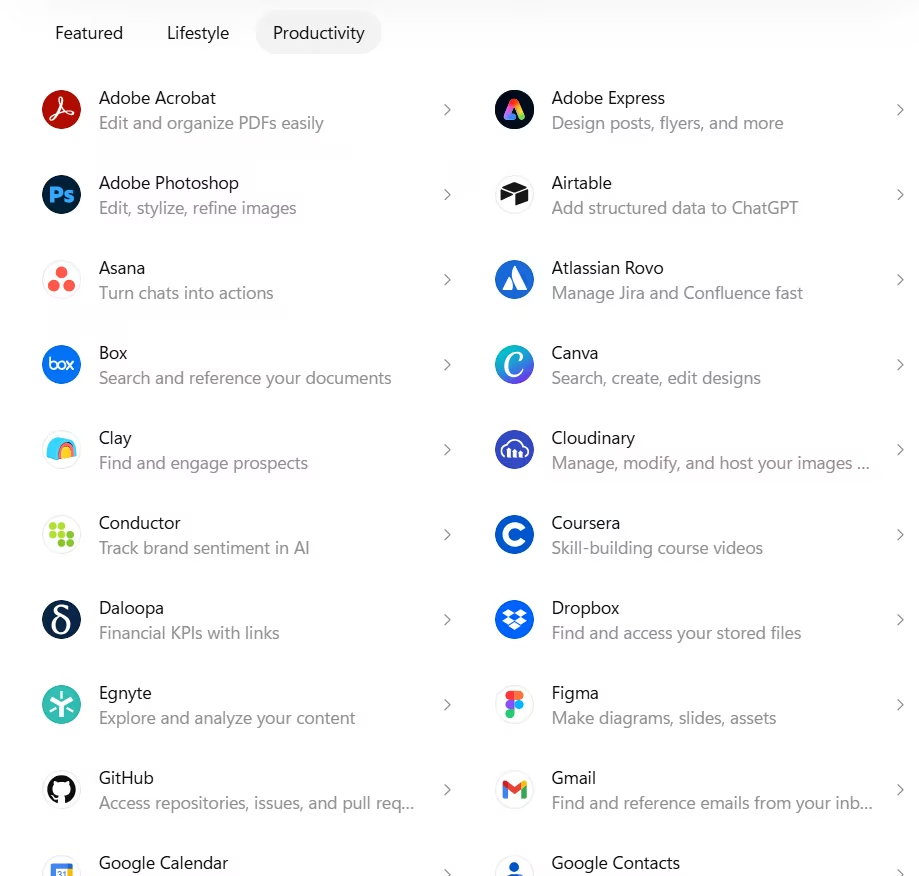
Because they know that, to be useful, they must support our daily work, so the more connectors, the better. That is step one. It's one thing I figured out early in my AI experiment, and I solved this problem by hooking Make.com scenarios into my Claude Desktop.
OpenAI, Anthropic, and others believe they are pursuing an ecosystem play, or maybe they are pursuing every play, because no one really knows how this will play out.
If the first step of realising the great productivity leap is connecting everything together into one GPT environment - which acts a bit like a command and productivity hub - and using it to ‘do things’ like ‘hey update my Asana tasks with the work I have done today’, what is the point of having Asana?
And the even bigger question is, would Google and Microsoft not want to be that central hub - because they sort of are at the moment. Well, the answer is yes, enter betterGemini and Co-Pilot, both of which are looking to rapidly evolve from an annoying Mr Clippy on steroids, for those of us who can remember that, into also doing useful stuff.
But the fundamental upshot will be that there is a high potential we will be paying twice or for multiple subscriptions to do the same piece of work.
And finally, all the radial impact of AI on OPEX
Energy prices, perhaps obviously, will go up, but so too will water, as an average Data Centre uses about 300,000 gallons of water a day, and in the UK we already have a predicted water shortage without factoring in all the ‘critical’ AI data centres.
AI also needs lots of chips, storage and memory. A 1TB NAND chip went from £3.80 in July 2025 to £8.45 in November 2025, and prices will continue to rise until 2027, when the supply chains may be realigned. This will drive up the costs of smartphones, computers and laptops, which will go up in price - the latter mainly driven by the additions of GPUs to offload intensive AI tasks.
Broadband prices will go up because this stuff will overload your internet connection, and the infrastructure guys will need to add another layer of infrastructure to keep up with that demand.
And finally, in about 20-30 months, when the big SaaS platforms know which way the wind is blowing, and the Utility Platforms like Google Workspace and Office 365 have figured that out too, you, me, and every other business will get slapped with more “AI Backtaxes”.
That will also feed into our consumer world, and we will get a two-tier solution with an extra AI subscription, as Meta is experimenting with on their social platforms.
Pricing Weirdness and Practical Steps You Can Take
When you join up all the dots, it is no surprise that vendor pricing is irrational right now, oscillating between opportunistic, land-grab-style pricing and a defensive 'let's lock people in' approach, mixed with consumption-based pricing. Fundamentally, in all my years of running SMEs, we have never faced such pricing uncertainty or weirdness.
Extrapolating from the price increases Microsoft and Google are imposing, we are looking at a minimum of 20% in tech pricing; it is not impossible that we will hit 40%.
So here are practical steps you can take.
- Turn off any auto-renewals; this will force evaluations.
- Monitor underlying price rises to those long-term subscriptions you have locked in.
- Set monthly caps on consumption-based solutions (this feature is not always available).
- As a backup and often overlooked point, set category spending caps on those corporate cards.
- Review feature and function overlaps in solutions on an ongoing basis, as these are materialising at an alarming rate.
- Be prepared to be agile and nimble as you revisit how technology supports your business.
Plan for an OpEx increase either through direct AI subscriptions or price hikes, as I have described. Nearly all platforms use an assumed opt-in policy rather than a consent-based opt-in, and, again, as if by magic, at the time of writing this, I received a 'Gemini for BigQuery will be auto-applied' email.
So your teams need to be vigilant, and I would suggest you set a company policy for someone to proactively evaluate the opt in to the auto-applied AI - particularly if it's consumption-based.
This is one for finance departments which liked SaaS for its predictable pricing; they will need to factor in more consumption-based pricing going forward.
Most importantly, understand how the ecosystems of AI tooling are playing out, and align and adapt your business to the one that will give you the most competitive advantage. Be technologically nimble and smart to leverage opportunities.
Pricing weirdness and unpredictability will persist for the next two to three years.
And then everything will die back down. Half the data centres probably won't be used, and we will end up with very, very cheap storage capacity. Because forget profit, those things will need to be serviced somehow or other. Because no one really knows where this is going.