


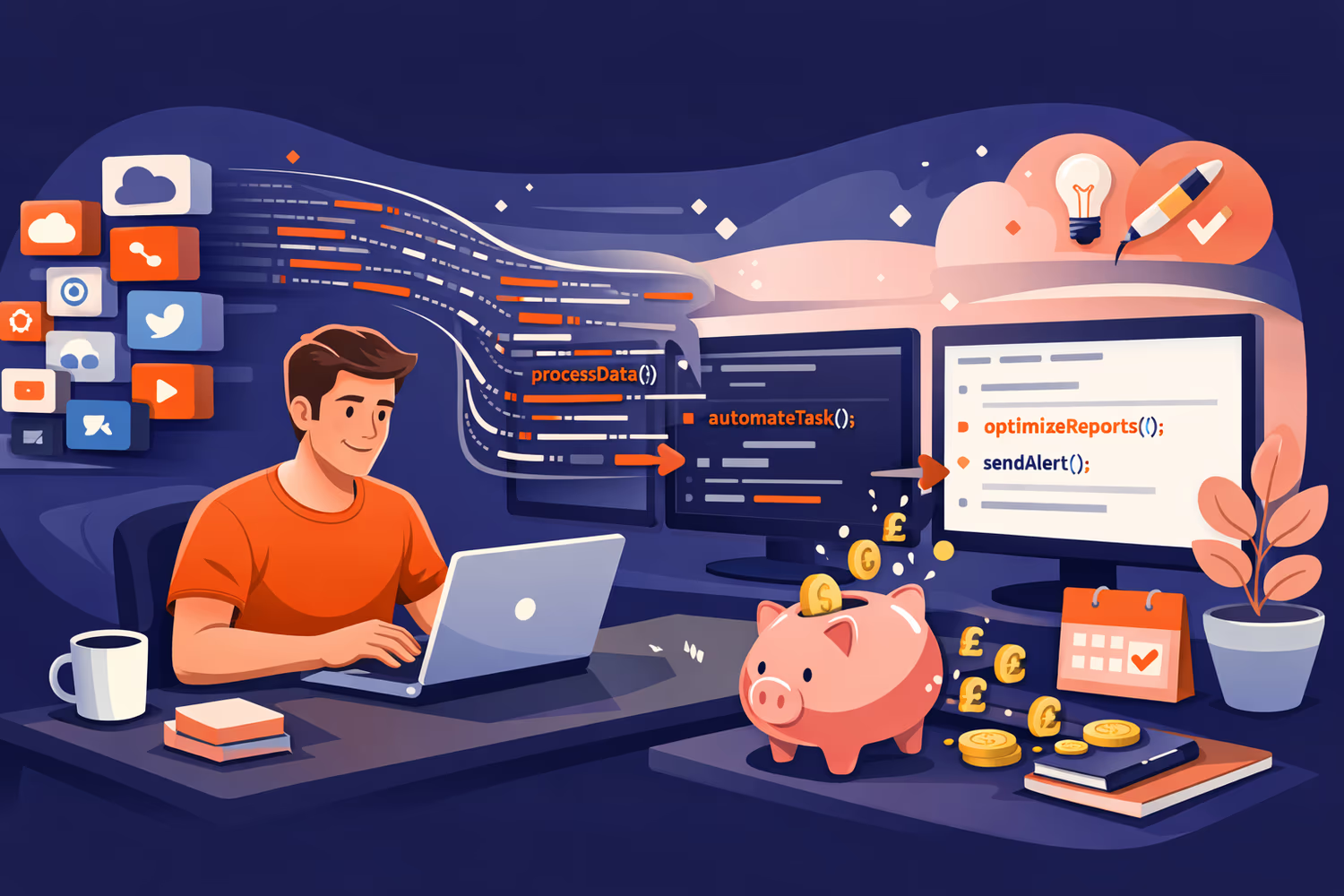

The Boring AI Revolution? How Simple Code Is Saving Us £24,000 (The Wins Nobody's Chasing)
There's a reason the Winklevoss twins don't run Facebook—they couldn't code, Zuckerberg could. Now every small business has a coder on tap. I'm not saying you'll create the next Facebook. The opportunity is more immediate and smarter than that.
Cash flow is the number one killer of small businesses. Trust me, I've been there. If you activate the coder you now have on tap, how much could you lower your operating costs by? That's the question.
While the AI hype focuses on what the next big disruption will be, let's start delivering real benefits now. GPTs are great at coding for small deterministic tasks, which gives us something we've never had before.This realisation came as I extended my Human (i.e. me) In The Loop Experiment. One aspect of the experiment is how AI changes business operations, so I had to create a “business” to experiment on. And I started going Ok, I need a way of publishing from Google Docs, managing the content schedule and so on, very soon, I was looking at c. £2,000 / month just in SaaS subs - but we are in a different world now.
From my personal experience working with small businesses, well-defined, specialised code can solve many workflow, automation or productivity problems.
Two years ago, perhaps even six months ago, the way to solve those problems would have been to spin up a subscription to yet another software-as-a-service provider or online API provider to solve that problem for you.
The Practical Reality
I'm not suggesting every small business becomes a software development shop. That would be missing the point entirely.
What I am saying is this: those monthly subscriptions you're carrying for simple automation tasks? We can eliminate a significant number. Those workflows you've compromised because "that's just how the software works"? You can now create exactly what you need. If you have the ambition, and if it will give you an advantage.
What previously stopped us from creating our own code is now different. The back-and-forth with a GPT isn't like back-and-forth with a developer - you're having a conversation, refining in real-time, getting immediate results.
The code is transparent. The maintenance means asking questions in plain English. Updates involve describing what you want changed in terms of outcomes based on evolving business needs.
Let me give you some examples. They may be unexciting in terms of what they do, but it is usually these more routine-sounding tasks that we can easily replicate. By looking for these, efficiencies and cost savings can compound very quickly.
Example one: the cookie consent banner.
A GPT will provide you with a script to insert, making it native to your site. This means your site won't be dependent on a third-party service and won't experience slowdowns. It can be optimised for speed. Previously? You're paying £15-30 per month for something that increases load time and creates another dependency.
Example two: image resizing.
Everyone knows that image size is important. Many CMS systems are ok at that or you may not be using one that does it for you. While most will. However, the result can still be impacted by the size of the image you uploaded initially.
Trust me, optimising the original image before you load it, and then letting your CMS perform further optimisation, will give you a significant speed boost. A GPT writes that script for you in minutes: no monthly subscription, no plugin slowing your site down.
Example three: Google Docs to CMS publishing.
This one we've actually implemented. You can create a Google Doc with all images properly inserted, then publish it to your CMS. Again, a GPT will write a perfectly good script for you to do that. The last example is slightly more complex and requires some iteration, but the GPTs handle the bulk of the coding work.
These three examples, built for Digitising Events, demonstrate how quickly we can put them into production and how we can adopt a different OPEX model.
And there are lots of other examples, where in the past you would go, "Ah, we need to solve this problem," and if someone piped up with the idea of "Hey, maybe we could get someone to programme it for us," a lot of what I call institutional barriers would come up:
1."It will cost too much"
2."There will be a lots of back and forth"
3."We'll create a reliance on the developer"
4."How will we maintain it?"
And so on and so on.
Many of those concerns become invalid when you have access to GPTs. I'm not saying you should always go down that route. However, we would be foolish not to activate this capability where relevant if we're considering an AI business transformation.
It will free up time to focus on identifying where human value lies and creating jobs that leverage our unique human capabilities.
What This Actually Means For Your Operating Costs
The original promise of cloud computing was to provide compute power everywhere for everyone at a fraction of the normal costs. And that promise was always true. AWS, Google Cloud, Microsoft Azure - they've been offering incredible capabilities at low cost, especially at SME volumes, for years.
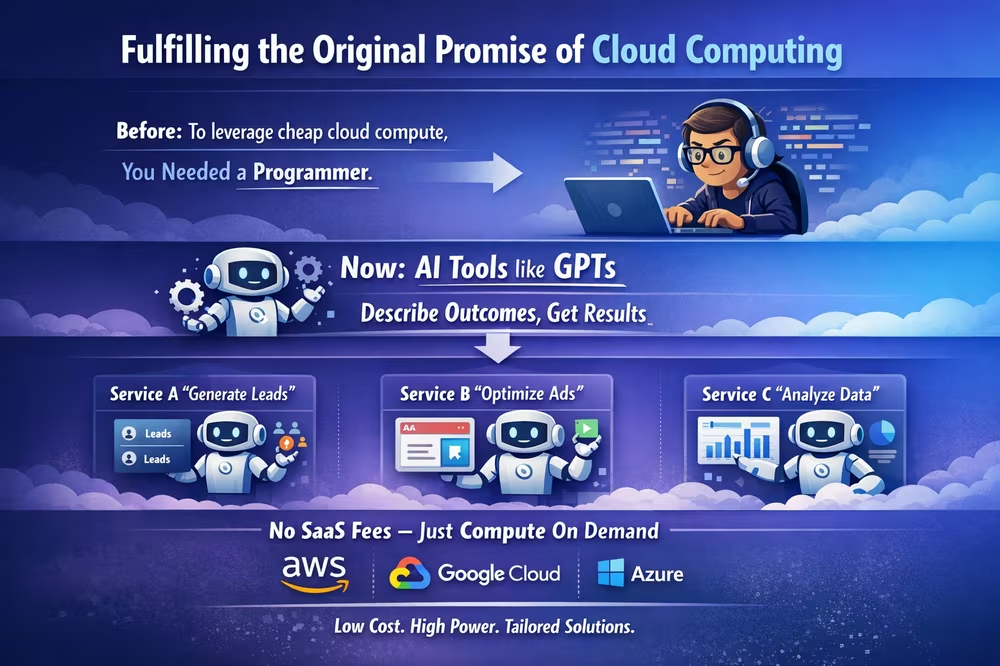
But here's why that promise never materialised for small businesses: to really get or leverage that cheap compute, you needed a programmer.
Now we have one - or many in fact.
You know what? I do believe that Silicon Valley has shot itself in the foot here. The first job they're going to be disrupting at scale is that of a low-level programmer. However, what GPTs offer is the ability to fulfil the original promise of cloud computing.
What you can now do is describe a very clearly defined outcome and have one service that works toward that outcome. Nothing is stopping you from creating two or three versions of that service that attune to different kinds of outcomes, because the cost impact is negligible.
And the reason why the cost impact is negligible is that you're not paying a SaaS provider - you're using compute on demand on one of the cloud platforms.
The £2,000 Question
I've compiled a list of solutions I'm familiar with in my domain: publishing and events. There's close to £2,000 worth of monthly OpEx savings by activating this approach to solving your business problems.
That's £24,000 annually. For a small business, that's not optimisation, that's a major win.We're not alone in recognising this shift. Make.com, the automation platform we rely on most recently, has launched a module that accepts code directly from your GPT of choice. For many workflows, you won't even need to spin up a microservice in Google Cloud. The barrier just got lower.
Where The Human Value Actually Lives
Through our Human in the Loop experiment, when you cleverly and symbiotically offload work to GPTs like writing short bits of code, or creating supporting images for content, something interesting happens to where you spend your time.
We ran a test. Had a GPT create "perfect" thumbnails for our YouTube content, optimised colours, text placement, the works. What contribution did that make to views? About 2%.
Meanwhile, the videos where we take the time to tell a story, share genuine insights from our experiences, and synthesise what we're learning. Those are getting hundreds of views with zero promotion - and no thumbnail.
That 2% from the thumbnails isn't unimportant. But it's nowhere near as valuable as freeing up time to find the stories that genuinely help people. The GPT can handle thumbnail creation, the cookie consent banner, and image-resizing scripts.
You need to focus on identifying which problems are worth solving, which insights are worth sharing, and which stories actually matter. And more fundamentally, have the slack to consider how AI will change my business models so I can adapt, react, and innovate.
That's not a compromise. That's where human value concentrates when the mundane becomes automated.
What You Should Actually Do
Start small. Pick one problem—maybe that cookie banner, perhaps some image processing task. Ask a GPT to solve it. Experience the process before you scale up.
Then look at your bank statements. Every recurring charge for simple automation? That's a candidate. Not everyone will be replaceable, but enough of them will be that the savings compound quickly.
Calculate not just the money saved, but the time freed. What could you do with an extra day per week not spent wrestling with software limitations? What problems could you finally address if cash flow weren't so tight?
The Boring Revolution
This isn't happening in headlines. It's happening when you get annoyed at paying a ridiculous subscription to get a workflow done, or need an impossibly complex number of platforms for what should be simple. It occurs when a small business discovers it can reclaim OPEX to invest in storytelling rather than struggling with image formatting scripts.
Now the programming barrier has fallen. The £2,000 monthly question is on your desk.
What you do with that capability is up to you.