



AI Megatrend 4: AI and The Great Fragmentation
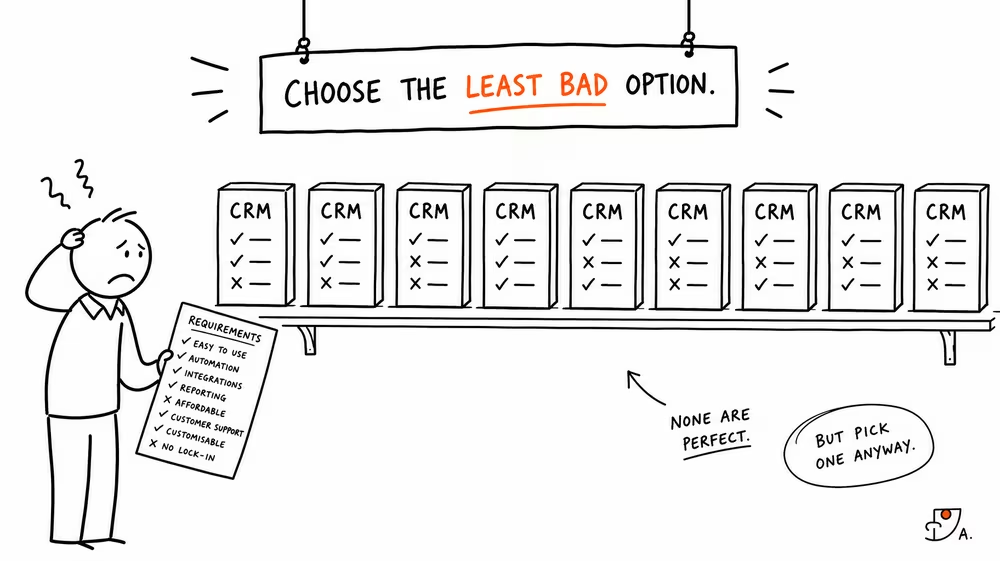
There is a question worth sitting with before we get into this one. On Make.com, an automation platform, there are 362 CRM integrations. On Zapier, too, over 1,800 app integrations are categorised as “CRM”. If you think about that for a moment, you could be forgiven for asking: Do we really need over 362 CRM systems?
Probably not. But we got there for a reason.
It’s Already Started
Every one of those CRM variants exists because a genuine business need created it. B2B versus B2C sales workflows are fundamentally different animals as an example. Healthcare has HIPAA. Some businesses want an end-to-end funnel baked in, which is why HubSpot built what it built. Others want a clean, simple contact layer for direct sales and nothing more.
The survey and form tool market tells the same story. Typeform exists because how you ask a question and the user experience affects completion rates. Jotform exists because some businesses just need a functional form without the UX overhead. Each one is, essentially, a different philosophy for the same task, capturing information from someone, packaged as a product.
So we did not fragment because of market chaos. We got it because every business has nuance, and being genuinely good at customer acquisition is a competitive advantage. The tools followed either a real or perceived need.
But, and this is interesting, even with 362 CRM options, business is still compromising. For many SME’s the CRM is essentially the “operating system” a lot of things run on top of it. And right now, you are building your operation on someone else’s architecture, shaped by someone else’s assumptions about how a business like yours should work.
If the need for differentiation is strong enough to generate 362 products, why stop there? Why would the answer be “choose the least-bad fit” rather than “have the exact fit”?
That is where this observation is going and is the first fragmentation driver.
The Skill Tax Handbrake Is Removed By AI
The second fragmentation driver is quieter but arguably more consequential. The barrier to getting systems or solutions that fit your vision are a direct result of what I call a ‘skills tax’. And often the need is simple, like “Why don't we have the right variations of landing pages to support our audience acquisition?”, “Why can't we have our own HubSpot or Salesforce driven event registration experience”. I could list more, but it would make for a dull read.
The point is that many SMEs have been carrying an increasing ‘barrier of compromise’, and the compounding effect of solving many simple things can give you a significant edge.
Take as an example BigQuery, or any data warehouse. For years, getting a useful answer out of one required knowing SQL. Most of the time, the questions were simple enough that dashboards covered them. But every once in a while, you needed to interrogate a nuance, and suddenly you needed a specialist. That ‘skill tax’ is one of many barriers removed by AI.
You can now talk to a data warehouse in plain language and get meaningful answers. And what most people are missing is that in many SMEs those questions can be quite simple yet high in value.
AI has effectively unbundled the skill stack.
Previously, if you needed statistical insight from your data, you hired someone who knew both statistics and SQL, because you needed both to get anything done. You paid a premium for the bundle. Now the SQL layer is a LLM problem, so you can hire for the actual intellectual need, which is statistical thinking. You find the right brain for the right problem, at a price that reflects that discipline.
The same is now also true for how you hire other specialists. You no longer need a Webflow specialist; you need a design specialist. Or if you need a kick in your audience acquisition “must know HubSpot” is probably not really a hiring constraint.
What AI is blowing apart is the bundled expertise model. The tool-specific knowledge layer is being stripped out, and what remains, and what becomes more valuable, is the underlying discipline: design judgement, statistical thinking, audience positioning, and transformation expertise.
That multisided model, which meant if you wanted Salesforce in your enterprise you had to pay the local accredited 'implementation partner', is what is under threat, and about time.
Configured Bespoke: A New Kind Of App
The third fragmentation driver is perhaps the most significant for SMEs, and the one that will take the longest to fully play out but offers significant business advantages.
There is a category of problem that every business has always had but never solved. Not because the solution was unclear, but because it could never pass the economics test. The idea was too specific, too small, too idiosyncratic to justify the cost of a SaaS provider building it properly. So it sat there as accepted friction.
I will give you a concrete example from my industry. A business running four or five niche conferences a year, perhaps 100 to 200 attendees each, needs a networking platform for six weeks.
What they need is simple: a few specific rules about who can contact whom, some speaker access controls, and their branding. The solutions on the market charge thousands for platforms engineered to handle every permutation imaginable, most of which are irrelevant. So they either overpay, compromise, or go without.
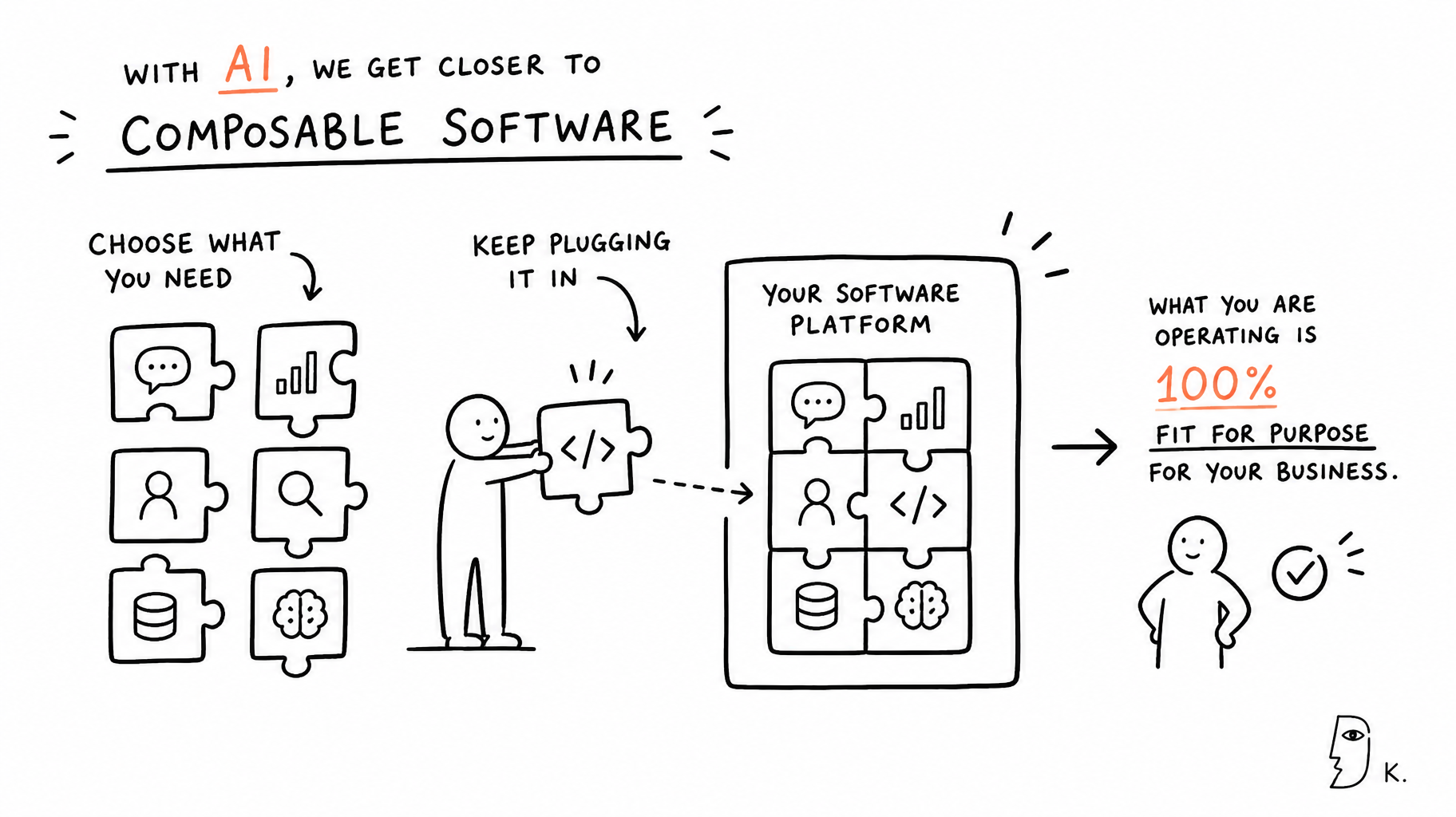
That equation has changed. You can now specify your exact requirements and get a working application built around them, not a generic template you are adapting your workflow to fit.
When building Digitising Events as a live experiment in AI-powered operations, I saved £24,000 in start-up costs by applying this principle to a series of well-defined, specific technology needs. That is not a marginal saving; it is a different way of thinking about the utility of new tooling to solve business technology problems.
The model here is closer to configured bespoke than to traditional software development. Moreover we are already using it.
As a parallel let me take you back to the dark ages of early websites, to make any of them look good you would pay £1,000s to get some templates done and pay for every change, true story. Fast forward to now. Want a news site? Pick your CMS, find a template, apply it - job done (well 80% of it anyway). This works because at the core of it 95% of features, functions and so on are common to most site variations.
I have seen the future and the same will be true for applications. And it's scaring the SaaS companies.
Let me bring this to life with an application most of you will have had some experience of, e-learning. None of the SaaS platforms, and I have tried over 20 of them, offer anything revolutionary. The requirements are pretty stable, host videos, set quizzes, ask questions, take payments and so on. For most use cases that is plenty until it's not or it's too much. You either feel like you are overpaying or are short changed.
Now, with AI-enabled tools like Base44, Lovable, Cursor, Windsurf, and whatever the latest start-up is. You are closer than ever before to get solutions that match your exact aspirations or experience you want. Because all you would do, and I am simplifying for dramatic effect, but not by much, is download your base template for e-learning and then add your differentiations to it.
The simplicity I have described above is on the near horizon. For many of the largest companies in the world technology and digitisation is a core differentiator. The way we have been “buying” technology as SMEs meant we could never actualise technology as a competitive advantage in the same way.
There is no point embracing new tools like generative AI if we don't line up behind new opportunities or ways of working.
Fragment Towards Digital Independence
We are, in a strange way, closer than ever to realising the true potential of cloud computing: the ability to create infinite useful, specific digital experiences sustainably and at low cost.
The compromise that has always been part of a small business's technology infrastructure whether that be in direct costs, workflow optimisation, or just in accepted friction, is becoming more of an active choice.
Not for every problem, and not without effort. But for a meaningful category of specific, well-defined business needs, the threshold for “this is worth building exactly right” has dropped dramatically.
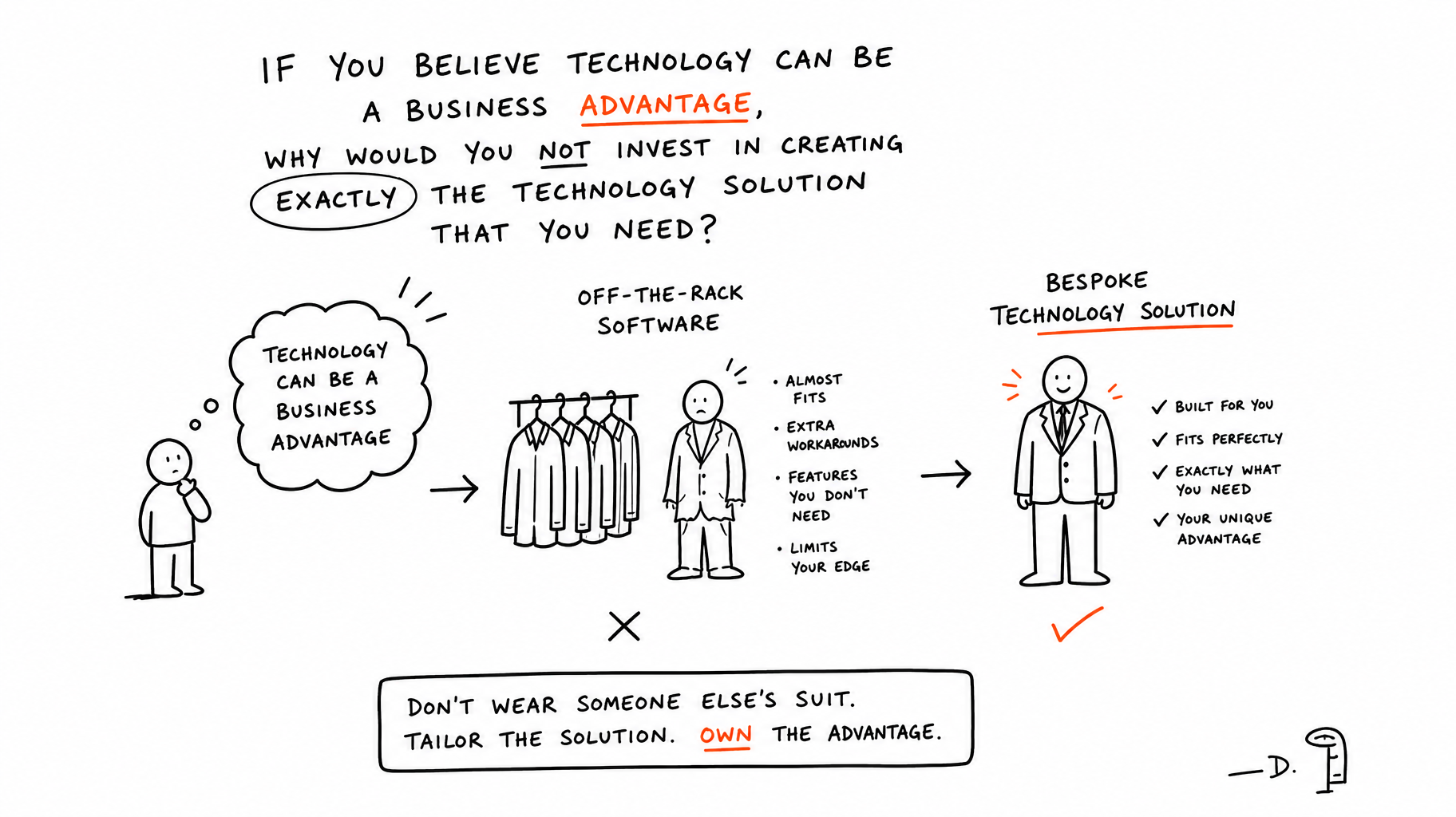
The businesses that move first on this will not just save money. They will operate on technology that fits their methodology and visions like a glove, rather than adapting their methodology to fit someone else’s technology. That is a different kind of competitive advantage from the ones we have been talking about for the last decade.
The fragmentation has already started. What is coming is an acceleration of it, and a mutation into something more interesting than just more choice and for technophilic founders and owner managers it offers very different options as well as a stepping stone to true digital independence.