




AI Megatrend 3: Jobs Messaging Shift - From Displacement To Symbiosis
When the AI wave hit (and I'm talking about the chatbots here), I, like everybody, went, "Holy shit, this is going to change everything”. I downed tools and said, "You need to understand this because your digital transformation work is going to need you to understand this technology in order to help companies adopt it."
Having done that, I can confidently call BS on the narrative that AI is going to replace every job. Is it going to be transformative? Is it going to be disruptive? Is it going to change the way we work? Yes. But is it going to displace jobs as quickly as the AI sellers would have us believe? No.
This article is a mix of retelling my journey in working with AI coming to a concrete position of where the value truly lies and how new and interesting jobs can be created through symbiotic AI working. Let's set aside for a minute, for the purposes of this article, the fact that there are many forms of AI. I'm talking about the GPTs and their impact here.
If you're interested in reading a different view of how we can shift value creation with AI and retain human talent in the process, then read on.
AI Can Do Everything….
I've met a lot of investors, and many of them have the attention span of a fly trying to deal with the pane of glass. Maybe because they get pitched all the time. The point is, to get attention, you need a sound bite. There is nothing more powerful than saying “we have built a technology that can do every job”.
This is a sound bite that has unlocked billions of dollars, and so it must be continually reinforced. And what better way of reinforcing it than not just saying it, but showing that you have had to downscale your workforce because of AI?
For a while, you buy into this because when you use the chatbots, they are genuinely clever and helpful, and because of their training, know perhaps way more about a certain domain than you do. But that's just vomiting Google on you.
When you look deeper behind a lot of the employee rationalisation, let's be euphemistic about it, you could argue that that is because the businesses were in trouble in the first place. Like Jack Dorsey making around 4,000 of the staff at Block redundant, or Oracle preparing to cut thousands of jobs ‘because of AI’ which when you look deeper is actually as a result of a cash crunch due to massive spending on AI data centres.
Or Wix, a platform we have used, reportedly planning its biggest layoff to date, cutting 20% of its workforce after weak earnings and increasing AI-related costs. Which is again caused by, ill thought through, AI integration. Delivering features not based on customer needs and with no meaningful customer benefit.
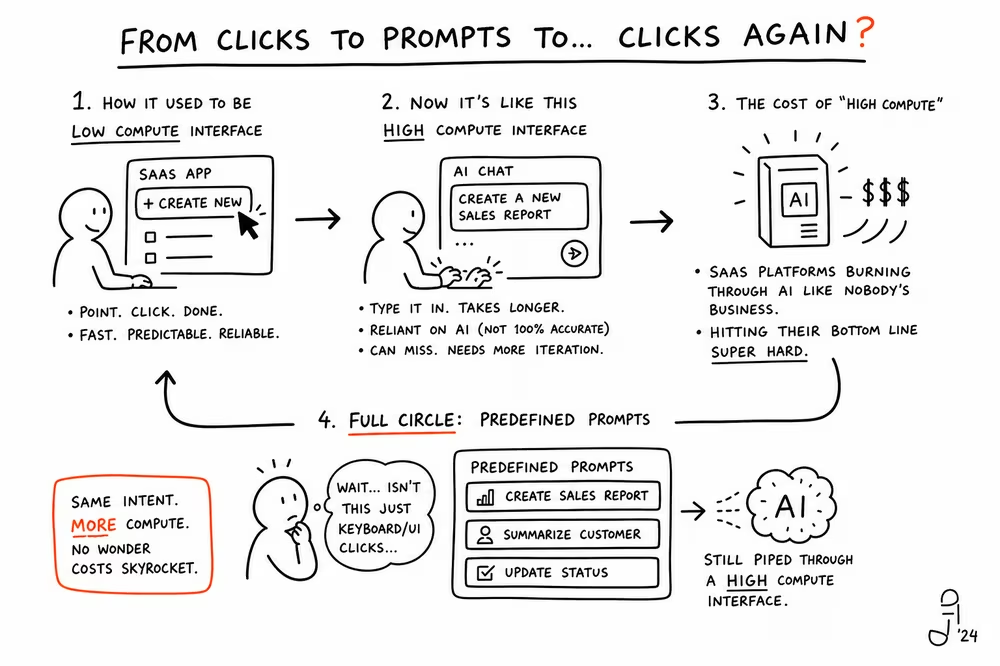
Benchmarking for hype
The next thing you need to do to reinforce the hype is to prove how smart these things are. I kept seeing these new evals that blow one model out of the water over another model, and it's like an arms race. The trouble is that these ‘evals’ are very defined tests. That is a bit like saying someone is ‘book smart’. My point here is that the evals just show that the LLMs are very smart at solving specific tests when trained properly, and that's amazing. But the real world is way messier than that.
That is not to say that AI isn't going to be disruptive, particularly for SaaS companies. I mean, why would I need Grammarly when I can train my chosen GPT to do its job?
So, of course, AI will force corrections, and there will be job losses. But that is just history repeating itself: every shock has created job losses, and every shock has also provided an excuse for making them. This has all happened before.
Three years in, though, CEOs of the big companies are asking where these promised productivity gains are, as the PWC survey showed.
“56% say they have seen no significant financial benefit to date” PwC’s 2026 Global CEO Survey
The soundbite of displacement is running out of road. Fast.
Reporting from the frontline
One of the things I did in trying to understand the application of this technology, and again, I'm focusing on GPTs here. Is to, as an experiment, try and run an AI-driven media business, which is what this site is.
That decision allowed me to experiment and test the assertions that are being made around AI and content in particular.
What I share now are two case studies from that journey, and like most people, I did buy into the throwaway line of "AI can create content based on your thoughts. In fact it doesn't even need your thoughts, it will just do it.” but that is far from the reality.
Case Study: Writing With AI
In the beginning, a wave of solutions, most of which I tried, came up with the selling point of "we can create content from a couple of sentences” for your blog, publishing etc, and you can run it on using AI's favourite word “autopilot".
If your only measure of a successful blog post is word count, then yes, the content engine was automated. But that metric was a Google invention from an era when volume implied authority, a logic the SEO community hijacked long before AI arrived to finish the job. So, that promise of full automation was true in terms of volume and velocity, but it broke completely in terms of engagement and attention. For obvious reasons.
That is not to say AI is useless for content creation. It means you have to completely flip the workflow and place AI in the right part of the process to create genuinely engaging content. And that is the hard part. The graphic below shows the workflow we arrived at to create this article as an example.
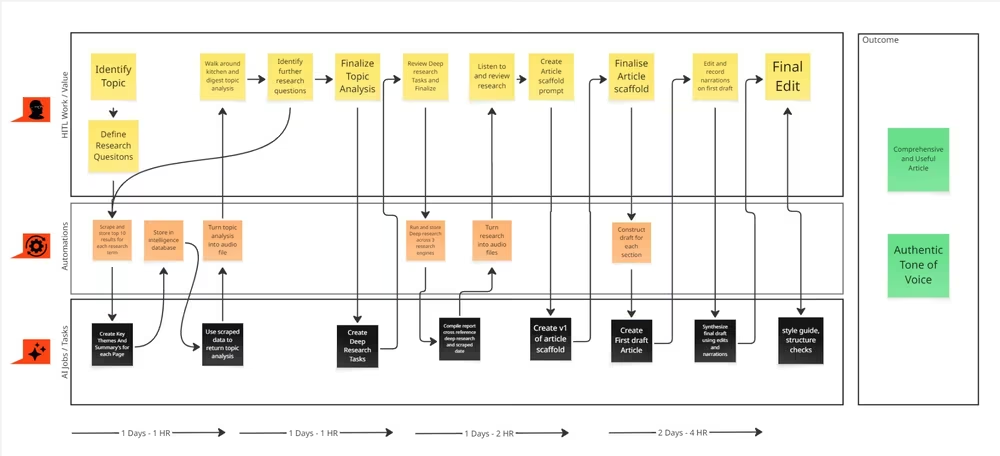
Engagement rates on these articles are hitting two to three minutes on our website.
Some of the things this flow does are:
In parallel it runs research jobs which are used to flag discrepancies or add to the authors notes.
Voice files are loaded into an AI system that ‘understands’ basic argument structure, and using that material, it creates content ‘scaffolds’ that are built on over time. In parallel research jobs are run to support or debunk where the author is going. The result is nuanced with human expression rather than stripped of it.
The big point here is adopting a symbiotic way of working with AI does not replace the author. It shouldn't frighten the author. It enables the author. It does however change the way work is done, and people must be open to that.
There are two new skills at play here, one is forensically exploding the workflow and the other is being able to iteratively add AI in the the right places, in the right way.
Then assembling the tooling so that it is frictionless in the creation flow.
Or here is another one, it comes from a real pain SMEs have. Particularly at the ‘S’ end of the spectrum, and that is getting actionable insights from your unstructured data, in real time.
Case Study: From Comment Sections to Content Intelligence
Four years ago, on a transformation engagement, the longest-serving editor at the publisher I was working with had a conviction: there was value buried in the comments section of their community site. And he was probably right. They were one of the few publishers I'd worked with who had actually managed to get a community up and running, vibrant and active, with real audience participation. The problem was getting anything useful out of it at scale.
The business had tried various approaches. What actually worked was the editor, every week, going into those user-generated comments himself, reading through them, and divining a thread based on his own domain knowledge and experience. It was entirely manual, entirely dependent on one person, and impossible to systematise. The vision, a weekly report that automatically surfaced what was resonating with the audience and what wasn't, stayed exactly that:
A vision.
Fast-forward to now. That problem can be solved, and I've proved it myself.
Here was my setup. The starting point was YouTube comments. I pulled them all into BigQuery (a simpler job than you may think).
Then I ran some very defined and simple AI routines to do more preparation on each comment as it arrived, like categorising them into low or high signal and a few other things I won't share here.
Then we connected that up with Claude Desktop, and the starting query became: “Do you see any trends?” Claude runs the analysis across all the comments, surfaces patterns, and flags what's resonating.
You can even get it to build dashboards and visualisations if that is useful. For me the point is that you are not putting all your energy into “dashboarding” but rather preparing the data so it becomes useful to a subject matter expert. That is still a very human job, the AIs screw it up every time.
And they can work with it in an environment which has the ability to give them that information how they want to consume and distribute it. And it's not just them; others in the business can question that data from their perspective.
What changes is that your data team is no longer responding to requests or building infinite variations of dashboards because you don't know what you are actually looking for.
Their time is spent on the very interesting work of preparing the data to be accessed in this way. And companies may want to hire more people who can do that.
Just two examples, but they underscore the same point: putting the AI interface in the right place, in the hands of people who know what they're looking for, is where the value is created.
A big part of the learning from the experiment of building Digitising Events was that symbiotic human/AI systems always delivered better outcomes.
Underestimating The Handbrake of Human Inertia
The irony is that the very thing that makes the displacement narrative attractive to investors is the same thing that makes it unworkable in practice and will be the handbrake. Because over 95% of the economy does not work in a big tech company. From personal experience, and I have been doing digital transformation for a while, the single biggest hurdle to creating an impact in a transformation project is to assuage people's fears that the equation:Digital transformation must =Job redundancy, is not correct.
Only when people understand that transformation, when done well, means your work becomes more interesting, friction with the mundane is removed, your skills grow and that they can open new career paths.
Only when this aspiration is not only superficially accepted but genuinely believed does a transformation project get anywhere. Full stop.
Now look at what the AI sellers have done. They have unashamedly come in and presented how many jobs their technology can displace.
95% of the world's workforce are in SMEs and it is a bigger economic engine than the mega companies. This 'gold rush' that is steeped in so many ironies it would make Alanis Morissette proud. Will shudder to a halt if the narrative does not change.
Only Symbiosis Gives The Productivity Kick
What my work has shown me is that if you default to this notion that AI can do things on autopilot, you will be disappointed. What the case studies that I've shared above hopefully show is that, if you then take a step back and ask the question: How can I get to this defined outcome using AI do you get anywhere near delivering value.
My content experiment was only successful when AI was put into the right places rather than being in charge of the entire process. You just have to look at the early content on this site.
The big message, though, is that in order to get the productivity kick out of AI, it is only the symbiotic approach that will get it for you. And that is not easy to get to. You need to explode the process of work that you have learnt and accepted over the last 20 years in order to integrate this technology effectively. You also need to build the skill to know when not to ‘AI’. That takes time.
But by doing that job properly, we start to see where the new and interesting jobs will be, and how new systems of work will be created.
The current narrative is very dangerous
There's a real danger in wholly subscribing to the "AI will take your job" narrative. The greatest danger is making irreversible decisions now, a risk that is especially high for people like my daughter and her cohort, who are in higher education or at the early stages of their careers.
If you give up because of this narrative and fail to build the skills you need, the consequences are long-term. The same applies to your business.
AI will change our systems of work and it will cause disruption, and perhaps not in the way that the big tech companies would like it to happen. Like with anything that hits the real world, the results are never binary: ones or zeros, or black or white.
They're more likely to be a shade of grey. And there is a very real opportunity for not only people coming into the jobs market but also for SMEs to leverage and create something better. That is part of my next piece, which I call the great fragmentation.