


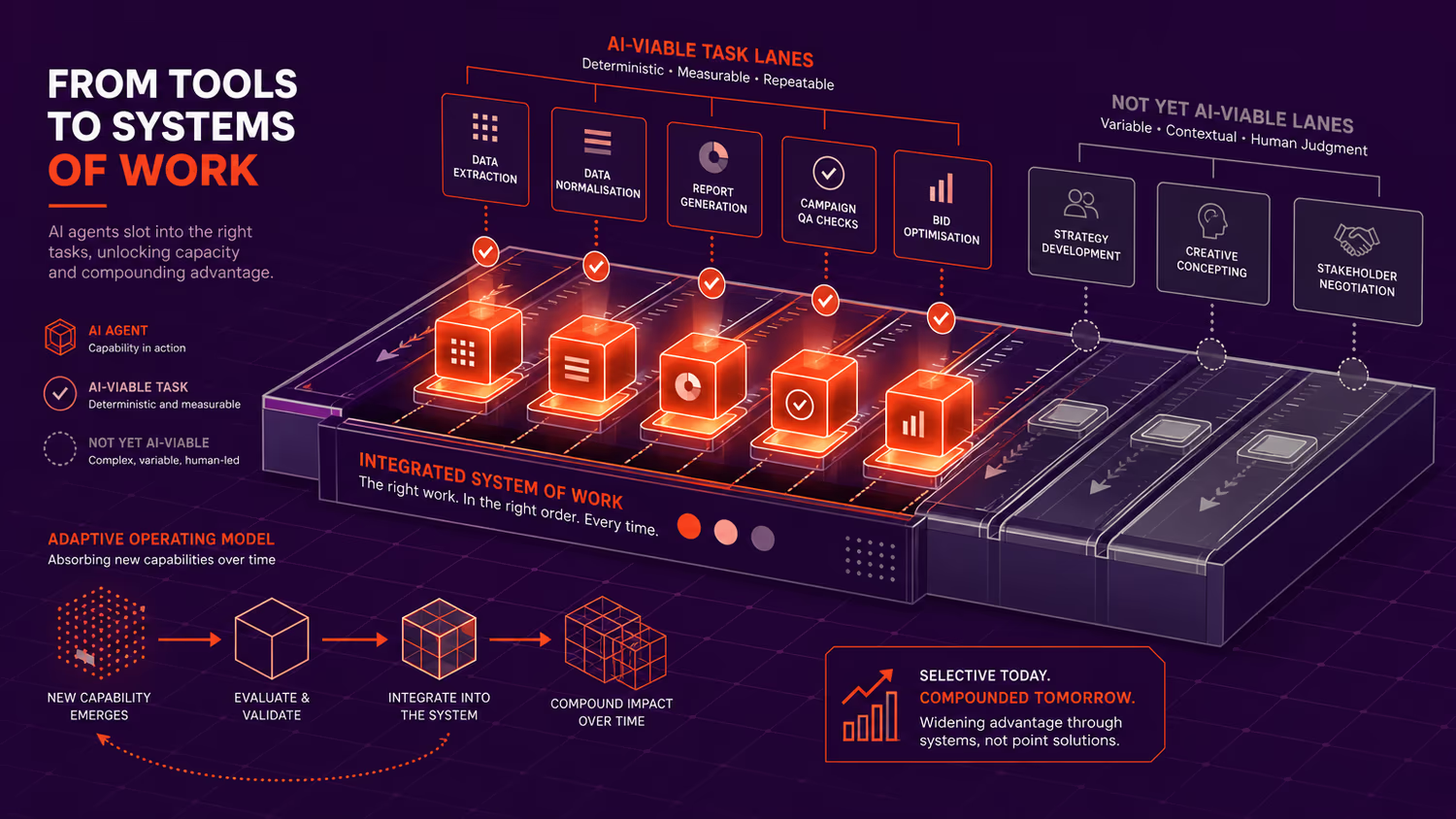
AI Megatrend 5:Agentic Enterprises Creating New Systems of Work
Every business will become an agentic enterprise to a greater or lesser degree. Agentic enterprises are those that are committed to designing systems of work which use AI for tasks as AI becomes viable to do those tasks. Their mindset moves from buying a subscription to integrated adoption: changing how work is done.My biggest mistake and most significant realisation has been that we are conflating work, jobs, and tasks.
AI, the generative kind, is very good at tasks. The more measurable and defined the task's outcome can be, the better. The chatbots Claude, ChatGPT, Gemini etc., also provide a ridiculous level of convenience to getting ad hoc tasks done.
The outcomes of jobs and work will not, in the short term (years I suspect), look particularly different. But an agentic enterprise will arrive at them differently. By pursuing an agentic system of work, it creates a divergence gap that becomes harder and harder to close.Agentic enterprises will not run around and stick AI into every single operation that exists today. They will be tactically astute in understanding the current and near term utility of generative AI and build the expertise of integrating tasks into an enterprise's system of work.
Whilst AI arrived in the collective consciousness almost like the Big Bang, the mistake most people made was to assume it would keep following that explosive adoption curve in all areas. For a time, it did.
What is happening now is a realisation that its utility evolution is fragmenting rapidly. And each fragment will follow its own pace and path to delivering utility. Some may never happen; others, like coding with AI, will become a given.
The chart above is illustrative of my own reading of the pattern. It was inspired by this video, "Understanding Technology Bubbles: Airships, Railroads, and AI Progress Clocks". It explained what I had been observing far better than I had managed to.
The key argument, in my view, is not whether an enterprise should adopt AI tooling and capabilities, but how to build an adaptive system of work and management that can integrate agentic utility as it matures for any given task.
The goal should be to give your talent new ways of solving problems and creating value, not replacing them or human labour as a whole.
What comes first?
The more deterministic your outcome is, the more likely it is that you can ‘agentify’ it. As evidence for this, you need to look no further than coding.
When you code something, the outcome definition is as close to binary as you can get it. Your code works, or it doesn't work. The same is true for maths problems, which you can see in the recent headlines of AI solving very complex mathematical problems by spending about $15 million.
The less deterministic your outcome, the harder it is for generative AI stack to hit that outcome repeatedly and consistently.
If you take creative writing, the outcome is not the amount of words you can generate, which current AI will beat you on hands down. It's how you construct the argument and write engaging prose.
Whilst the utility of AI is going to mature at different rates, in order to stay competitive and relevant, we still need to be designing systems of work that can very rapidly integrate (let's call them) AI nodes when the utility reaches a predictable level of maturity.
Things are viable now that were not.
There is a slow lane and fast lane of AI utility. The ripple effects of the large language model (LLM) race are making AI in all its forms more accessible than it has been before to a small or medium enterprise (SME). And things will move fast. One thing the agentic enterprise will know is that AI is not just your chatbot.
The table above lists very mature AI tooling, which would have been prohibitive in terms of cost and expertise 3-4 years ago. It does not take much imagination to see how they can help support enterprise operations.
In our experiment of building the agentic enterprise, we have so far shown that we can eliminate £24,000 of annual Software as a Service (SaaS) subscriptions, which have some form of AI, by going direct and having a system of work, which supports that option. You can follow that journey behind the scenes.
Whether or not you feel comfortable with adopting this route within your enterprise, or see its potential merit, is not the key point. The key point is this level of AI access was not a viable option 3 years ago to any enterprise that I was working with. It will change operations.
Machine learning is the new normal in the enterprise
What has happened is we have tipped into a reality where machine learning, of which LLMs are a version, is now going to be a fundamental part of your enterprise operations. In many sectors, it already was, which is why, overnight, so many software platforms could almost instantly say, "It's an AI platform." The word AI became a marketing tool overnight.
Here is an example from our own work, which shows you how accessible this now is. At trade shows, which are usually free to attend, most organisers have an overall idea of how many free tickets will actually walk through the door.
But, it would be better to know that on an individual level. We created early machine learning models to predict this, already in the pre-chatbot world.
That work took us 6 months. We were able to complete a like-for-like outcome, with some improvements, in 2 weeks, because the LLM helped us iterate faster and supplemented knowledge gaps to enable new markers.
Those of us working in the field know, however, that a machine learning model needs iterative supervision and enhancement. For many smaller enterprises, whilst machine learning has always been out there, it was not a toolset that could be actively utilised.
That has now changed. Three years ago, I could not have handed most clients a model with confidence and let them iterate on it; now I can.
Computer vision: a case study
This one is perhaps a bit of an example from left field. The ability to apply computer vision coupled with AI to give you real-time analytics of live events has become immensely more accessible.
The example I use here is from grassroots football, where, if you wanted to have detailed analysis, it would cost the club a small fortune to get that type of video analysis. It is now being given away for free as part of the subscription from a major football analytics camera company.
I include it because it is demonstrable proof of the price-point shift. Three years ago, this level of analysis was accessible only at higher-level academies; now it is accessible to most grassroots football.
Playbooks are being rewritten
The biggest reason to create new systems of work in the agentic enterprise is that playbooks are being rewritten very quickly.
The best example is Search Engine Optimisation (SEO) and the old contract that valuable content would be rewarded with traffic. That broke in 4 years, and for many SMEs, it created a real shock.
A lot of the tech that you use delivers its value because of the cornerstone of predictable business playbooks.
But, when those playbooks are being rewritten on the fly, you must pay attention and move towards becoming an agentic enterprise.
What is the agentic enterprise?
The agentic enterprise, in my view, is one that institutionally understands the potential of AI as a technology beyond LLMs and chatbots.
It is also one that is actively and aggressively looking at existing systems of work to see where AI can play a role to do tasks and support its existing talent in creating valuable outcomes.
It is designed in such a way that it is effectively a hot-swappable business. Functions can become more agentic and more supported by AI without the traditional friction.
Why now?We are at a point of inflection I have seen many times before, but this one is playing out much faster. Blockbuster had a slow demise; this inflection may not give you those timescales.
The divergence gap opens whether you start or not; the only choice is which side you are on.