


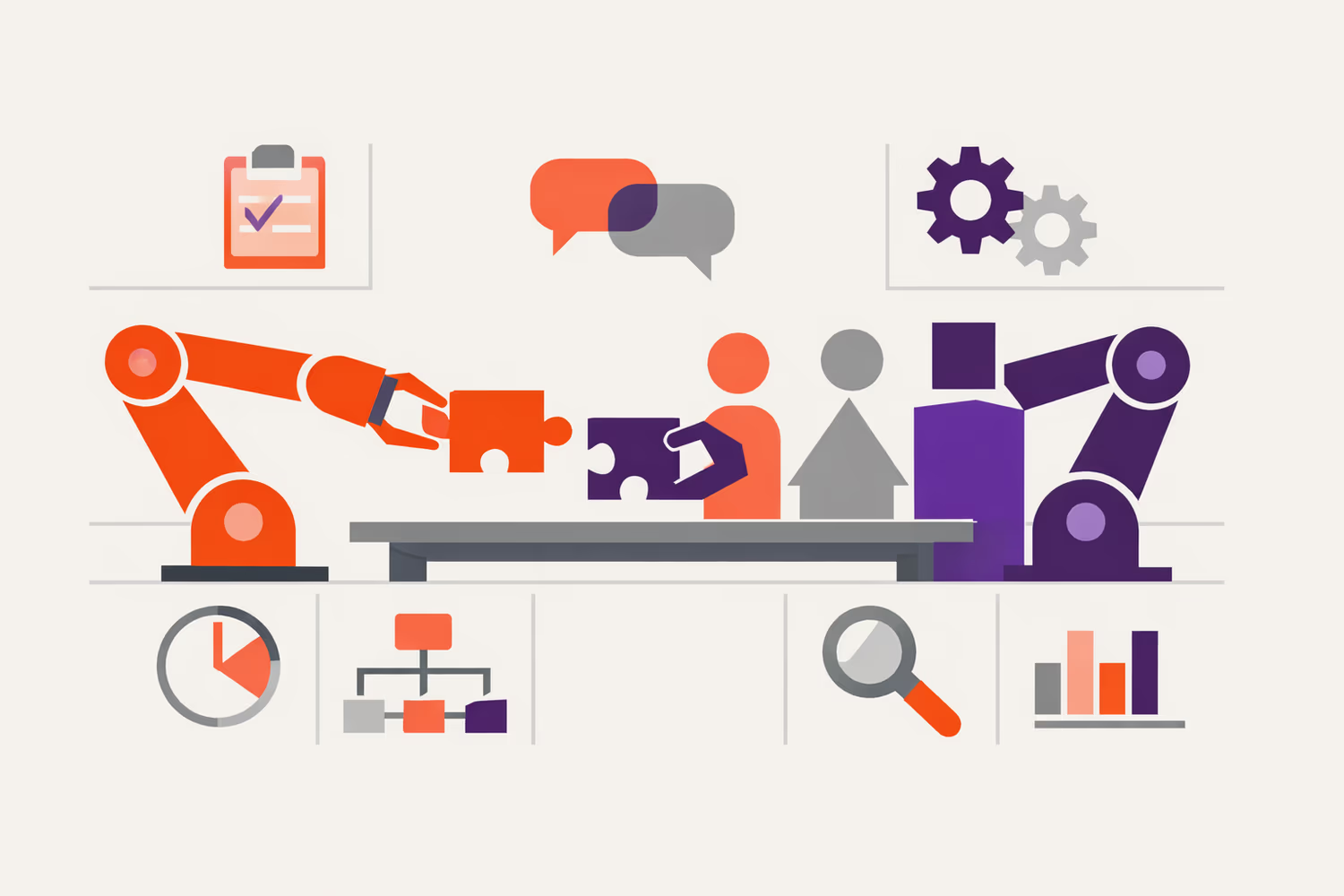
AI and the quiet rehire
Yes, it's true. Companies are rehiring the people they made redundant in the name of AI. Kalana has done it, IBM has done it, and research firms now expect roughly half of all AI-attributed layoffs to be reversed. So in Covid, we had the great resignation, and then when AI started, we had the big job killer. So all these things go in waves and cycles. But the reason why the Quiet Re-Hire is not being shouted about is because it still doesn't suit the narrative.
All is not roses, though, because digging into all the news articles and having read big long pieces, almost none of the workers are coming back on the same terms. That is in itself worth paying attention to. My personal opinion is that the job for life was a moment-in-time reality (50s, 60s, late 70s), but throughout human history, most people have never had a job for life.
So while the headline is the quiet rehire, the real story is how we are moving towards everyone having a much more fragmented way in which to earn a living.
What is the quiet AI rehire?
We all observed, from 2024 to 2026, companies, usually tech companies or large internationals, shouting loudly that AI is letting them headcount. Buying into the AI hype without proper testing in reality the gaps are then found out, and the same capabilities are rebuilt, but without the press release. The rehires are almost quite by design because admitting you need the humans back is a worse look than the original announcement.
This should, by the way, be good news. But the damage of those headline announcements and press releases has already been done. Many people are still stuck in the reality that AI can do everything we can and are making life decisions off the back of it. That is dangerous.
And while the work returns, the terms with which you're engaged are downgraded or perhaps not as familiar as we have been led to believe our work should be. Salaries people become contractors, onshore becomes offshore, an experienced professional becomes an entry-level hire making sure AI tools don't mess things up.
All of this, by the way, is not just an AI thing. The Great Resignation during COVID produced very similar patterns once the world started getting back to normal. We need to wake up to the fact that the way we earn a living is going to become increasingly fractional.
Are companies really rehiring the workers they replaced with AI?
They are, and the clearest case is also the most public. Between 2022 and 2024 Klarna cut around 700 customer service roles and replaced them with an AI assistant built on OpenAI's technology. The company claimed the assistant did the work of 700 agents. By May 2025 the CEO, Sebastian Siemiatkowski, told Bloomberg the cost-cutting had "gone too far", that quality had dropped, and that customers needed to be able to reach a human. Klarna started hiring agents again.
It is worth noting that this most public case, Kalana 700 Agents figure, was its own PR number announced with its AI vendor. It wasn't an audited account, and much of the headcount fall came through attrition and a hiring freeze rather than a clean swap.
This is worth understanding because the viral version of every one of these stories is tidier than the messy reality underneath. While the rehire is real, the way it was originally positioned or subsequently is much murkier.
Big Blue did much the same thing. In 2023, the CEO, Arvind Krishna, said the company would pause hiring for back-office roles and that AI automation could take over, and pulled out of thin air the figure of 7,800 positions across five years.
While IBM did replace around 200 HR roles with an agent called Ask HR that now handles the bulk of routine HR queries. Something strange happened in February 2026 when IBM's HR chief announced the company was tripling entry-level hiring in the U.S., explicitly including “all these jobs we've been told AI can do”.
Her reasoning was not sentiment. Cutting the bottom of the ladder, she argued, creates a long-term scarcity of mid-level and experienced people, and it's a false economy that is dressed up as efficiency.
IBM did replace around 200 HR roles with an agent called AskHR that now handles the bulk of routine HR queries. Then, in February 2026, IBM's HR chief announced the company was tripling entry-level hiring in the US, explicitly including "all these jobs we're being told AI can do." Her reasoning was not sentiment. Cutting the bottom of the ladder, she argued, creates a scarcity of mid-level and experienced people later, a false economy dressed up as efficiency.
So worth noting that IBM itself insists its total headcount went up over this period because apparently the money freed up by automation was spent on other roles. That is in stark contrast to the simple "fired for AI, rehired for AI".
What is happening is people are being rehired into redesigned jobs, doing things that this generative AI-led automation cannot do.
It is not just me seeing this pattern, the data bears it out. Foresters 2026 work-of-the-future research found that 55% of employers regret their AI-driven layoffs and expect around half of the AI-attributed cuts to be ever so quietly reversed. Often offshored or at lower pay.
Gartner too expects half of the companies that cut customer service headcount for AI to rehire in similar functions by 2027. This, in my mind, again is just a realignment behind outcomes and where people are best placed to deliver them.
And a survey of 600 HR leaders reported that more than a third spent more on re-staffing than they saved by cutting the jobs in the first place.
Which companies have reversed or rebadged AI-driven layoffs?
The most documented cases, in short:
- Klarna cut ~700 support roles for AI, then restarted hiring, piloting a flexible "Uber-style" remote agent model rather than restoring salaried posts.
- IBM replaced routine HR work with an agent, then announced it was tripling US entry-level hiring for roles it had said AI could do.
- Salesforce cut around 4,000 customer support jobs in 2025, citing its Agentforce agents, before reporting emerged of the company walking parts of that back.
- Amazon cut roughly 30,000 corporate roles across late 2025 and early 2026, the largest in its history, with AI cited as a driver.
- Block cut around 40% of staff in early 2026 with an explicit AI rationale, and the stock rose sharply. Bloomberg immediately raised the question of AI washing.
- Meta laid off thousands while, on the same day, moving thousands of remaining staff into new AI-focused units. The same people, the same skills, new labels.
In my work, I have stress-tested what AI's capabilities are at the moment in terms of this idea of doing everything that we are capable of doing. It is a lot further off than many of the people building frontier models would like us to believe. What the patterns are showing, however, is that it is very rapidly reframing the nature of work in terms of what talents we need to build out and where humans add the most value. My most optimistic view of this is that we will be doing more interesting work than we've ever done before, particularly in the domain universally classed as knowledge work.
Did the AI actually do the work?
Sometimes, and partly. The honest answer is more nuanced and doesn't fit into a headline. Kalano's Assistant, for example, did resolve millions of simple tickets very quickly. IBM's agent does handle most routine HR queries. It is not that AI does nothing.
It is the old 80/20 rule. AI can very easily handle the 80% of the simple cases, and the hard 20% (complex, contextual, and emotionally loaded situations) are exactly the ones that are driving customer damage when there is no human left to catch them. You could argue that that is a reworking of the service design, but I believe it is much more nuanced than that, which will be the subject of another article.
Fundamentally, the mistake that was made was that the people with the spreadsheet were scoping the automation by cost rather than capability, going live before edge cases were understood and finding out the damage that this caused only after customers started going public, because AI was blocking the routes in.
What is AI washing?
Fundamentally, AI washing, as with any of the washings, like sports washing, is the practise of attributing layoffs to AI transformation that a company has not really run yet or piloted. They do this to earn a valuation kick. And for a while, it worked. Attaching the letters A and I to a redundancy announcement reliably produced a stock lift. And the other thing it did was perhaps give an easy, low scrutiny, excuse for layoffs that would have happened anyway.
The numbers do give things away in the US alone. Around 946,000 job cuts were announced in 2025, up more than half year on year. Yet labour market analysis has repeatedly noted that there is very little evidence that AI is the thing actually replacing those workers in most cases.
It's a clever manipulation that has been used before because saying that trading is hard and underlying sales are stagnant or declining is not what a market wants to hear. Using the words "AI as a get out of jail free joker card" is a much better alternative. What is more worrying is if it is being used in that way, then there may well be a lag in reporting underlying trading, which may have a bigger effect on the global economy, but we will wait and see.
The other thing that is stopping this is that investors have started to catch on. Goldman Sachs analysis found that AI-attributed layoffs are beginning to attract a small share price decline rather than the old premium. The hype has stopped delivering a return.
You know when you are right when the person who kicked off the ‘AI will do your job tomorrow’ headlines, Sam Altman, called out AI Washing at a conference in India. And you know that the media is asleep when that did not ripple through the ‘news ether’
So did AI take the jobs, or not?
To answer that question, we have to decouple the word "job" and "work". AI did take work, but it does not look like it has taken jobs.
And in my own experience over the last 18 months of applying AI within businesses, it is more than likely to take work that was never really high-value work. And give us reframed and redefined jobs where the OG-AGI (aka humans) is better than anything that we have got in the technology toolkit at the moment.
What AI is driving is a complete reframing of how work is done within the sphere of knowledge work. It has delivered a novel capability that we haven't had before, but it is just that: a piece of technology to be designed into our working lives.
You would not, for example, go back to having a manufacturing production line without robots. The big disruption has been how quickly and almost synchronously AI was seen as the magic bullet. When it is not.
So jobs, if you want to use the traditional meaning of the word, will reappear, but not in the exact way in which they were cut. We will see new roles being defined at a very quick, imaginative, and alarming rate. But that is just the reality of when technology drives a flip, and the one thing that we have never seen is technology arriving in the way that generative AI has.
In the most negative outlook, what has happened is the technology gave employers a credible reason to reset the price of labour, and a significant number of them took it.
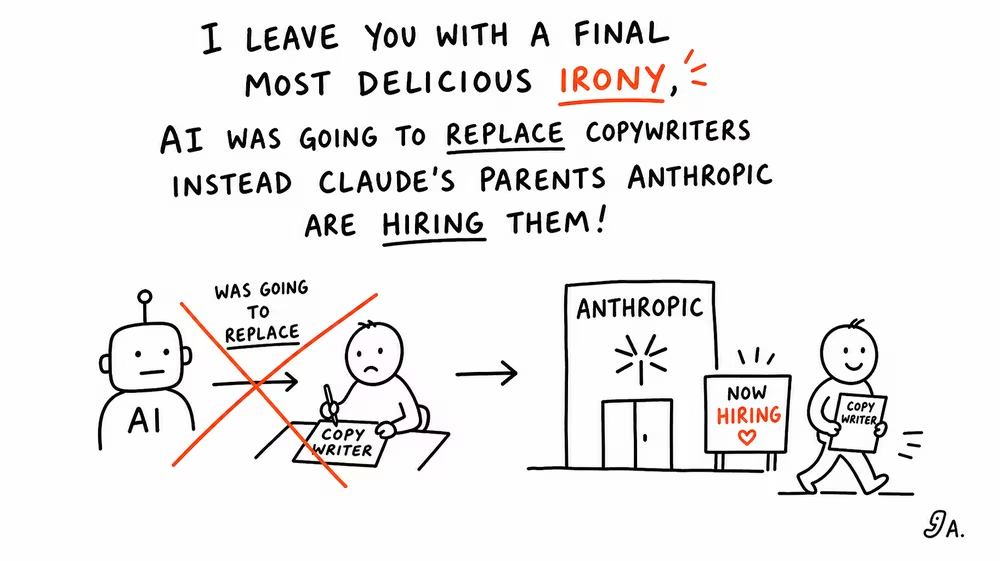
What does the quiet rehire mean for a smaller business?
I would say it is small and medium enterprises that are to be credited with providing the firewall between all the AI hype and the reality of the future of work. In Big Corporate Theatre land, an organisation automates by spreadsheet. It is unable to see its own operations closely enough to know where the real value sits. I'm not saying people within the organisation don't know it, but they don't have enough upward influence.
And the default way is to cut by the headcount. I've been through this personally, and you then discover the frontier that you have pushed too far, almost by accident and more dangerously in public, at a cost to your brand reputation. The businesses also have investors to perform for, and that produces all of this washing in the first place.
We independent operators have neither of those problems, and that is our advantage. We can see our own operations, much as I have done, and you know which parts of a job are routine, repeatable, and which parts are the judgement that holds a client relationship together and makes them into loyal, repeating customers (because in most cases the people leading the business have done those things themselves).
In my view, the practical lesson from every one of these cases and from my own learning is not to avoid AI. It is to understand with honesty and veracity where it can perform a function in a predictable and repeatable way. We keep humans reachable because that is fundamentally still the glue between us delivering products or solutions that have real value at the other end.
A SME does not live in the abstracted world of corporate headquarters.
This is the entire human-in-the-loop philosophy that I arrived at about a year ago, being realised in a very expensive way. We humans are the intelligence that must decide where automation belongs. And it feels like these big corporations are, in effect, discovering this human-in-the-loop approach by first removing the human and then watching a slow-moving train wreck.
Frequently asked questions
Which companies rehired workers after AI layoffs? Klarna and IBM are the most documented. Klarna restarted customer service hiring after cutting roles for an AI assistant. IBM tripled US entry-level hiring after replacing routine HR work with an agent. Salesforce, Amazon, Block, and Meta are all cited and establish the wider pattern, though the detail varies by company.
Is AI washing illegal? Not in itself. It sits in a grey area of investor communications rather than a clear breach, which is part of why it spread. The market correction has come from investors pricing it in, not from regulators, at least not so far. A form of AI washing can also be witnessed in those ads being run by Google and Microsoft, like the one by the pizza guy in New York using co-work to create a spreadsheet for a business model - no one has been able to recreate that.
Will most AI-driven layoffs be reversed? The research firms think a large share will. Forrester expects around half of AI-attributed layoffs to be reversed, and Gartner expects half of AI-driven customer service cuts to be rehired by 2027. The consistent caveat is that the rehire tends to come back at a lower cost. However, new roles are being discovered that command a higher remuneration.
Does the quiet rehire prove AI can't replace jobs? No. It shows that AI clears routine work well and struggles with complex, creative, contextual work, and that many companies enacted the cut by cost rather than capability. The lesson is about AI work design and sequencing, not about whether the technology works.
What should a small business take from this? Enact automation to where it genuinely beats a human, keep a human reachable for the cases it does not, and do not let a savings target dictate when you switch. Smaller operators have the advantage here, because they can see their own operations closely enough to scope honestly and grounded in reality.